What Prednisone Is Doing to Your Eyes — and Why Most Patients Never See It Coming
When a physician prescribes prednisone, the conversation that follows typically covers the familiar territory: weight gain, blood sugar fluctuations, sleep disruption, and the importance of not stopping the medication abruptly. What is far less likely to come up — at least in the examining room — is what the drug may be doing to the patient's eyes.
This is not a minor omission. Corticosteroid-induced ocular complications are among the most thoroughly documented adverse effects in the pharmacological literature, yet they remain among the least discussed in routine clinical encounters. For patients who rely on prednisone to manage serious inflammatory or autoimmune conditions, that silence can carry real consequences.
The Mechanism: How a Systemic Drug Reaches the Eye
Prednisone does not act locally. Once metabolized into its active form — prednisolone — it circulates throughout the bloodstream and interacts with glucocorticoid receptors in virtually every tissue in the body. The eye is no exception.
The lens, the trabecular meshwork that regulates fluid drainage, and the retinal vasculature all contain glucocorticoid receptors. When corticosteroids bind to these receptors over an extended period, they can trigger structural and functional changes that accumulate silently, often without any early warning the patient can perceive on their own.
This is precisely what makes corticosteroid-related eye disease so clinically challenging: by the time a patient notices something is wrong, the underlying change may already be well established.
Posterior Subcapsular Cataracts: The Most Common Ocular Complication
Among the eye conditions linked to systemic corticosteroid use, posterior subcapsular cataracts (PSCs) are the most frequently observed. Unlike the age-related cataracts that develop in the front or nucleus of the lens over many decades, PSCs form at the back surface of the lens and tend to progress more rapidly.
Patients with PSCs often describe difficulty reading, sensitivity to bright light, and a halo effect around light sources — particularly at night. Because these symptoms can be subtle at first and are easy to attribute to aging or fatigue, many patients delay reporting them.
Research has consistently shown that the risk of PSC development correlates with both the dose and the duration of corticosteroid therapy. However, it is important to note that there is no established "safe" threshold that guarantees protection. Cases have been documented in patients on relatively modest doses taken over extended periods. Children on long-term prednisone therapy appear to be at heightened risk and warrant especially close monitoring.
Elevated Intraocular Pressure and Steroid-Induced Glaucoma
A second significant concern is the effect of corticosteroids on intraocular pressure (IOP). In a subset of patients — sometimes called "steroid responders" — systemic or topical corticosteroid use triggers an increase in IOP that, if left unaddressed, can damage the optic nerve and lead to glaucoma.
Estimates suggest that somewhere between 18 and 36 percent of the general population may be genetically predisposed to this pressure response. The challenge is that most patients do not know whether they fall into this category until their pressure is actually measured. Elevated IOP produces no pain and causes no visible changes to the eye. A patient can be losing peripheral vision to glaucomatous damage and remain entirely unaware.
This is why baseline intraocular pressure measurement before initiating long-term corticosteroid therapy is not merely a precautionary formality — it is a meaningful clinical safeguard. Patients with a personal or family history of glaucoma, those who are highly myopic, or individuals with diabetes face an elevated baseline risk and should discuss this explicitly with both their prescribing physician and an ophthalmologist.
Retinal and Vascular Changes: A Less Discussed Risk
Beyond cataracts and glaucoma, long-term corticosteroid use has been associated with a range of retinal complications. Central serous chorioretinopathy (CSC) — a condition in which fluid accumulates beneath the retina, distorting central vision — has a well-established association with both systemic and inhaled corticosteroid use. Patients may notice that straight lines appear wavy, that a gray or blurred spot has appeared in the center of their visual field, or that colors look washed out.
Although CSC often resolves once corticosteroid exposure is reduced or eliminated, persistent or recurrent episodes can result in lasting visual impairment. Given that many patients on long-term prednisone are also managing conditions that independently affect the vasculature — such as lupus, rheumatoid arthritis, or inflammatory bowel disease — disentangling drug-related from disease-related retinal changes can be clinically complex. All the more reason to establish a clear ophthalmologic baseline before treatment begins.
Why the Eye Exam Often Gets Skipped
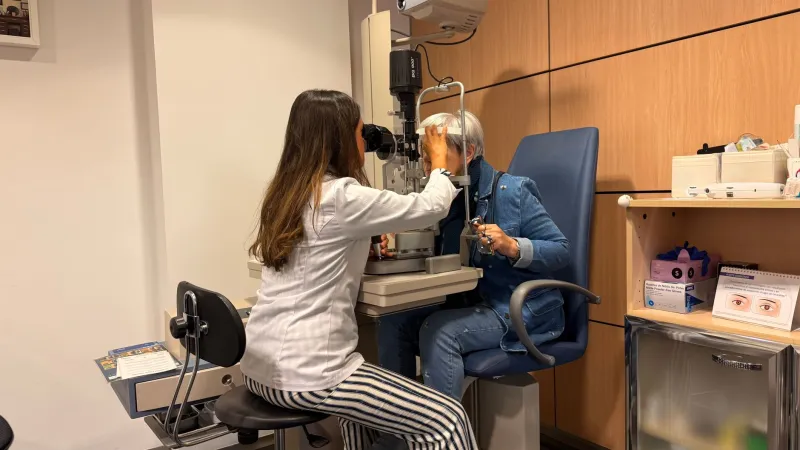
In an ideal clinical workflow, a patient newly prescribed long-term prednisone would receive a referral for a comprehensive eye exam before or shortly after starting therapy, followed by annual monitoring for as long as treatment continues. In practice, this does not consistently happen.
Several factors contribute to the gap. Primary care physicians and specialists prescribing corticosteroids may not have standing referral protocols for ophthalmology. Patients, for their part, may not connect a systemic medication to their eye health and therefore do not ask. Insurance coverage for preventive ophthalmologic screening varies and can present a practical barrier.
The result is that many patients on long-term prednisone have never had their intraocular pressure checked, have never had their lens examined for early cataract formation, and have no documented baseline against which future changes can be measured.
What Patients Can and Should Do
Advocating for one's own eye health while on corticosteroids begins with a direct conversation — ideally with both the prescribing physician and a licensed ophthalmologist (not merely an optometrist, though optometrists can also screen for many of these conditions).
Patients should ask specifically:
- Has my intraocular pressure been measured recently? If not, request a baseline measurement before or at the start of long-term therapy.
- Am I at elevated risk for steroid-induced glaucoma? Family history, myopia, and diabetes are all relevant factors.
- How often should I be seen by an eye care professional while on prednisone? Annual exams are a reasonable starting point for most patients; higher-risk individuals may warrant more frequent monitoring.
- What symptoms should prompt an urgent call? Any sudden change in vision, the appearance of halos, eye pain, or a new blind spot warrants prompt evaluation — not a wait-and-see approach.
Patients should also be transparent with their ophthalmologist or optometrist about all medications they are taking, including inhaled or topical corticosteroids, which carry their own ocular risks and are sometimes overlooked in the medication review.
The Larger Picture
Prednisone is a genuinely life-altering medication for millions of Americans managing conditions that would otherwise be debilitating or life-threatening. That clinical value is not in question. What is worth examining — and what this article is intended to support — is the importance of monitoring the full spectrum of risks that accompany long-term use.
The eyes are not a secondary concern. They are among the most directly and consistently affected organs in patients on extended corticosteroid therapy. Building ophthalmologic screening into the standard of care for these patients is not an overcautious measure. It is sound, evidence-based medicine — and it is something every patient on prednisone deserves to know they can ask for.